
Link to the Data Sharing Workshop and Summit.
There is a lot of energy right now around different ideas on how to share data across social media sites. Based on current discussions on the dataportabiltity.org lists and other places, it is clear that a range of potential standards and approaches are emerging.
The energy feels a lot like it did when Phil, Doc and I called the first Internet Identity Workshop – at that time there was a cluster of people thinking about and working on different technologies around user-centric identity. We had been meeting other conferences, but we had not spent time together to really hear different proposed approaches. They all had similar ideas. We recognized this and realized that if we brought them together, it would lead to the emergence of shared understanding and interesting alignments.
At IIW 1 the first day involved participants presenting their different approaches to user-centric identity. The second day was open space – an organized way to support critical conversations that emerged out from listening to all the presentations the day before. It was on that day that the serious conversation between Brad Fitzpatrick & David Recordon’s OpenID(1), Johannes Earnst’s LID, Drummond Reed’s xri/inames all had a conversation that lead to a commitment to meet up a month later and that conversation became Yadis – a group that was joined by SXIP a few months later and then a few months later this was all folded in and became OpenIDv2.
Another outcome of the Internet Identity Workshop has not matured yet but it is coming along. The card selector metaphor, interfaces and client code to do it are starting to be tested and deployed. The cooperate between Kim Cameron and his Microsoft team with IBM and the Higgins & Bandit open source projects has been fostered at these events. The OSIS (Open Source Identity System) Project and Concordia projects are both doing workshops interoperability testing at the forthcoming RSA conference. OSIS has over 200 test in their Interop. The range of actors (standards efforts, open source projects, commercial projects and companies) collaborating is impressive.
Phil, Doc and I didn’t know that these would be an “outcomes” of the event and certainly did not have it as a “goal.” What we did know was that by getting people together to share their ideas, technology approaches and standards, some good would happen – that is, collaboration, synergy and actual investment in and diffusion of user-centric technologies. We also chose a format with open space that left an open playing field – we were not deciding who got to talk, about what or when. This explicitly neutral unpolitical way of organizing also facilitated the collaborative environment.
My goal for the 2nd Data Sharing Summit is to bring together participants from
1) the large companies with 10s of millions of users like Microsoft, Google, Yahoo!, MySpace, Facebook, AOL, Amazon, eBay etc.
2) Small and Medium sized ‘web 2.0’ sites like LinkedIn, RapLeaf, Eventful, Dopplr, Linquia, Dabble, 30Boxes, Magnolia the whole range of Web 2.0 startups that are focused on services for people that involves peoples data.
3) The Standards Guys (Both adhoc and formal) Those putting forward a range of different approaches being proposed for managing the personal data/social network problem. This includes people from the user-centric identity efforts, semantic web standards and tools,
4) Social/Legal/Policy Implications Those thinking about and addressing the social and legal implications of the emerging technologies.
Bringing this range of people together will be key ingredient to getting this gathering be fruitful – I know because of who they are and the passion they have for the topic it will be. I am not going to define ahead of time “what the fruit looks like”
My hope is that there are some similar approaches that can discover each other “now” rather then a year from now when they are ‘going to market’ and decide to cooperate and merge efforts sooner rather then later (like happened with OpenID).
I asked two colleagues who will be attending what he thought the goals were:
* To establish shared consensus about the meaning of data sharing and portability for Internet users.
* To articulate a roadmap for how this can be achieved (and for determining “when we are there”).
* To understand what parts of this roadmap are technical and which are business/social/political/legal.
* To understand which technologies are available and which are emerging to achieve the roadmap.
* To determine how to move forward on the business/social/political/legal challenges.
* get disparate orgs ot work together
* get consensus on standards – and feedback
* identify missing standards
* get testing and compatibility labs -set up!
* and from an evangelistic POV – get Opt-In include din all systems
I think all of these will move forward in the format of Open Space and the collective participation and discernment at the beginning middle and end of the conference.
You can add goals here.
When I think about this gathering the big questions include:
* how do people link their information together across platforms with different services?
* how are permissions managed?
* what are the policies that apply?
* what standards exist?
* what code / frameworks are available to do this?
* what does it mean when my blog is the center of my network?
* is there a standard way to update presence?
* how do the identity tools (openID, oAuth, card selectors, data linking) apply?
* how do semantic web frameworks apply?
I hope to create a high-level professional community that is very engaged with these issues because they want to empower their users to have a copy of their data, to be aware of how it is used and to be able to use their data in interesting ways.
I also hope that a community will emerge that will work together, compete over different options and in the end solve the challenging set of problems that need to be addressed to get data sharing to work.
ID Topics
Does OpenID meet P___/Activist test yet?
Beth Kanter one of my favorite nonprofit tech friends Twittered this article The Cute Cat Theory Talk at eTech.
It puts forward an interesting hypothesis:
Based on my Tripod experience, I’d offer the hypothesis that any sufficiently advanced read/write technology will get used for two purposes: pornography and activism. Porn is a weak test for the success of participatory media – it’s like tapping a mike and asking, “Is it on?” If you’re not getting porn in your system, it doesn’t work. Activism is a stronger test – if activists are using your tools, it’s a pretty good indication that your tools are useful and usable.
The article goes continues summarizing a half dozen or more examples of how tools on the web have been used for activist purposes. It is an amazing list and worth the read.
I guess I am wondering if OpenID has been used for activism yet? I know that I have been evangelizing the concept in the NPTech community for longer then anywhere else – beginning at NTEN’s Nonprofit Technology Conference (NTC) in 2004. I am still not sure that it has sunk in or that they have figured out how to use it. Unfortunately I will not be at the NTC this year to find out.
Sorry – I am really trying to get openID to work on this hoster (well my tech person Lucy is) there is still something not working. So if you want to comment either link to this blog post and say it on your own site or send me e-mail kaliya (at) mac (dot) com. If any of you OpenID tech folks want to see if you can help her solve the problem let me know I will put you in touch.
on Hilary's Leadership

Geeks and Social Algorythms
There is lots of coverage of the inventor of Dungeons and Dragon Mr. Gygax. I have spent a few days working with material about reputation and the difference between human knowing reputation and computational reputation. I have been thinking about how geeks and those coding social software and how for me as a community organizer it so often misses the mark. This excerpt made me chuckle cause it reminded me of part of the reason why. From the NYTimes:
Geeks like algorithms. We like sets of rules that guide future behavior. But people, normal people, consistently act outside rule sets. People are messy and unpredictable, until you have something like the Dungeons & Dragons character sheet. Once you’ve broken down the elements of an invented personality into numbers generated from dice, paper and pencil, you can do the same for your real self.
For us, the character sheet and the rules for adventuring in an imaginary world became a manual for how people are put together. Life could be lived as a kind of vast, always-on role-playing campaign.
Don’t give me that look. I know I’m not a paladin, and I know I don’t live in the Matrix. But the realization that everyone else was engaged in role-playing all the time gave my universe rules and order.
We geeks might not be able to intuit the subtext of a facial expression or a casual phrase, but give us a behavioral algorithm and human interactions become a data stream. We can process what’s going on in the heads of the people around us. Through careful observation of body language and awkward silences, we can even learn to detect when we are bringing the party down with our analysis of how loop quantum gravity helps explain the time travel in that new “Terminator” TV show. I mean, so I hear.
Are adds with your name on them coming?
This is in the NYTimes:
To get one reading of this, I asked four Web giants – AOL, Google, Microsoft and Yahoo – a simple question: can they show you an advertisement with your name in it?
Lessig on the FCC and Internet
Lessig is on to corruption this is quoted from a recent interview he gave on the subject:
One of the biggest targets of reform that we should be thinking about is how to blow up the FCC. The FCC was set up to protect business and to protect the dominant industries of communication at the time, and its history has been a history of protectionism — protecting the dominant industry against new forms of competition — and it continues to have that effect today. It becomes a sort of short circuit for lobbyists; you only have to convince a small number of commissioners, as opposed to convincing all of Congress. So I think there are a lot of places we have to think about radically changing the scope and footprint of government.
Most interesting to me was when I was doing research very early on about this, and I talked to someone who was in the Clinton administration. They were talking about Al Gore’s original proposal for Title VII of the Communications Act. Title II deals with telecom and Title VI deals with cable and Title VII was going to be an Internet title. And Title VII was going to basically say, no regulation except for minimal interconnect requirements — so it would be taking away both DSL and cable and putting them under one regulatory structure that minimized regulation of both. When this idea was floated on the Hill, it was shot down. The answer came back was, “We can’t do this! How are we going to raise money from these people if we’ve deregulated all of this?”
So I completely agree. I think we’ve got to recognize that the way the system has functioned is to insinuate regulation in all sorts of places that aren’t necessary in order to fuel this political machine of fundraising. There’s this great speech of Ronald Reagan’s in 1965 where he talks about how every democracy fails, because once people realize they can vote themselves premiums, that’s what they’re going to do, and they’ll bankrupt the nation. Well, he had it half right, in the sense there’s a system where people realize they can vote themselves the benefits and destroy the economy. But it’s not the poor who gathered together and created massive force in Washington to distribute income to them. It’s this weird cabal of politicians and special-interest insiders that have achieved this effect. Basically, they can pervert the economy and growth in ways that protect and benefit certain interests.
Community to Community Diplomats and Diplomacy
I have been thinking a lot about how the different communities working on different aspects of open standards innovation for the web can understand how they are working together with each other – in relationship.
Community Diplomacy is the name I propose for a set of patterns and practices that already happens. By naming it and recognizing the people who do it – clarity could emerge.
Community Diplomat This is perhaps a new ‘role’ that if named in community can help bring clarity. These people can some times be called ‘evangelist’ but not necessarily. They are ‘sent out’ by one community on a mission to connect with and build relationship with another.
An example of this would be how Thomas Roessler Security Activity Lead at W3C have both done this for our respective communities. I first met Thomas at the W3C workshop Toward a More Secure Web – W3C Workshop on Transparency and Usability of Web Authentication. I instigated the writing of two papers that articulated activity going on in our ‘user-centric’ community one about Yadis and one about Identity Rights Agreements. I was bringing news from my community and taking back information from the gathering.
A few months later Thomas came to the Identity Open Space (Like Internet Identity Workshops but produced in partnership with other groups lie Liberty Alliance and DIDW) in Vancouver following a Liberty Alliance Meeting. He contributed to our meeting and took information from there back to his community (W3C).
Neither of us was going to become ‘full members’ the other community but we quite explicitly were there to grow mutual understanding and increase information exchange between our two communities.
I think there are a few more terms to help us be clear about terms and intentions. To talk about how we and the communities we are connected to can inter-relate.
Community Bridges These are people who are explicitly working to link different communities together – using social network analysis we see that communities have a core and a periphery. I know people are a part of many many communities – for the sake of this post I will just talk about the links between two communities.
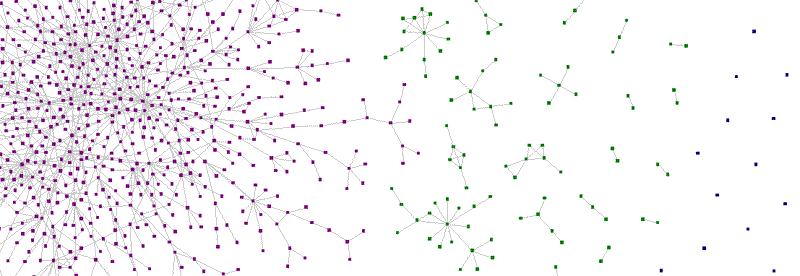
So there are several forms of being a bridge you can be:
At the core of both
At the core of one and periphery of another
At the periphery of both
It is important to remember the language of social network analysis is descriptive – cores are not better than periphery. The core of a network is the engine that ‘gets stuff done’ together they have strong ties – meaning the communication on those pathways is frequent AND they are all interlinked to each other. The periphery of a network has links to people in the ‘core’ but not to as intensely these are also called weak ties because communication happens less frequently. The periphery of a community is where new ideas come in through it is as important to healthy functioning as a connected core.
Examples:
Drummond Reed is a great example of someone who is rooted in several communities and fully participates in them. He is at the core of the XRI/XDI community and is a very active participant in OpenID (he is on the board). He is at the core of both.
Adriana Lukas who is in the VRM community leadership is a great example of someone who is very active in the core of one community – AND participating at the margins of several others related to aspects of the identity and technology that are needed for VRM.
I would describe myself as being in the periphery of two communities the Nonprofit Tech Community and the Open Source Community. I relationships with people who’s day to day work is deeply focused in these areas. I have attended both their major conferences for the past several years and my work relates to both but I am not at the Core of either community.
Community Cultivators – these people sit at the core of a community and work to grow and take care of it. They are looking out for new people who might contribute and helping them find a niche in the system. While researching this article I found my friend Jean’s article about Field Building that describes this process too.
Examples from the past week of work:
I inviting the two guys I met at the identity meetup Ryan and Tony we had in NYC to join Newbies 4 Newbies cause they are both new to the community & interested in learning more. I also connected with Mike Ozburn a long time community member via phone and in talking with him thought he would be a great fit for the Enterprise Positioning Group as he is currently working with Sprint.
Community to Community Diplomats and Diplomacy in Action
I think that if we name these practices it will be easier to trust/know that we have informational and relational links between communities via articulating these articulated – not formal but at least named connections.
I am watching the dataportability.org group begin a research initiative to understand what communities efforts relate to their goals. I know that I did and still do a lot of research and outreach for the Identity Commons community dating back to 2004 – out reaching to the SocialPhysics project at Berkman, to Doc Searls etc….
I hope the language put forward here can help us all be able to understand how we are linked and seek to build bridges between our efforts. There will never be ‘one’ organization or effort that links everything – there will always be many different ‘attractors’ that have different missions, strengths and purposes. I would like to see some further articulation of the practices and patterns that people who play these rolls do.
Identity Commons structure is designed to support the kinds of links – the people to people – community to community along with explicit information flow between groups to foster loose connection and space for collaboration between groups. Heallth of the overall identity commons community can be measured by the number and nature of cross community linkages (people). I have a post coming out shortly about the balance between parts (working groups) and the whole and how the balance we have is working and how it can be maintained.
Porn Spam App infects Facebook and "no one" cares?
Mary Hodder has a post up titled: Trashing Our Social Relationships (with Porn) to Get Your Numbers Up. It is quite insightful about the issues that aries when investment is based on ‘numbers’ rather then qualities of relationship.
This situation expresses clearly the social ‘issues’ that arise with the ‘open identity layer’ or ‘social layer’ or meta-systems. The kinds of behavior enabled via the social graph being ‘traversable’. I hope that some reason can prevail and the acceptable norms can emerge soon.
I wonder how open standards for portable social network information will deal with these problems.
The Porn picture app this is what happens:
Nothing “happens.” Except that the message was forwarded to the one person I left checked. In other words. It’s trick porn spam, features courtesy of Facebook and Slide.
So I sent in complaints to both companies (neither have contacted me back after a month — guys, it’s a social network, you know how to reach me.. give it a try!!)
After a while, I called people in each company that I knew through the tech comany. And was appalled at the responses I got. Now, these are people I know socially, and they gave me the real answers, but with the expectation that I would not attribute to them. However, I am confident that their answers reflect the culture and real value sets within these companies.
Facebook pointed the finger at Slide (the app maker in this case), and said, “There is nothing we can do. We have no control over the apps people make or the stuff they send.” Oh, and if I wanted Facebook to change the rules for apps makers? I’d have to get say, 80k of my closest Facebook friends to sign on a petition or group, and then they might look at the way they have allowed porn spam to trick people into forwarding, but until then, there would be no feature review.
Slide said that they thought Facebook was the problem, because as the “governing” body, Facebook makes the rules and “Slide wouldn’t be competitive if they changed what they do, and their competitors weren’t forced to as well.” In other words, Slides competitors use the same features to get more users (or trick more users as the case may be) and Slide didn’t want to lose out on getting more users with similar features, regardless of the effect the features have on us and our relationships.
Also both companies told me that blogging doesn’t affect them, because they don’t read blogs. The only thing they pay attention to are Facebook groups. Because they don’t look at problems that a single person discovers.
So in other words, a person with a legitimate complaint needs to have massive agreement and numbers in a Facebook group before these companies will even discuss a problem.
And, Slide and Facebook are willing to trash our relationships (real relationships) in order to get more numbers.
Now, note that many of the folks who sent the various porn spam (not just the ones in the photos above) sent very apologetic notes, because they were mortified that they had send their contacts porn spam.
Think about that. Your social networking / application software tricks you into doing something terribly socially embarrassing and you have to apologize? Wo. That’s really messed up.
In other words, your social networking software / applications are, gasp, anti-social.
So I have to ask, if these young boys (Zuckerberg, the app makers in the class at Stanford, etc) are so clueless about relationships and social protocols, that they would build apps and a system that promotes bad behavior like this, where are their mentors? Where are their funders (who presumably have some input and sway into what’s going on)? Why aren’t Peter Thiel and Dave McClure or even Jeff Clavier (who sounded like he was trying to or has invested in some of the guys from the apps class at Stanford) advising these people that while they are experimenting, that these are real established relationships, and Facebook is now mainstream, and therefore the apps can’t do this to people? I mean, it seems logical (and has happened in cultures around the world for millennia) that older, wiser men would advise young, clueless hormone driven boys how to act in the community. And what of Max Levechin? I mean, he’s kind of in the middle, age wise, but shouldn’t he know better than this?
Is the desperation for fame and money so great, that people would simply eschew social concerns in favor of ratings which then equal higher company valuations, and more billions on paper? Or do you want your claim to fame to be: “At least 15 million minutes wasted” from your experiments on Facebook (as I would imagine the Stanford student described above could claim)?
I guess the answer is yes, and so my response is, I can’t trust Slide, or Facebook. Nor do I have respect for their founders if this is the way they handle themselves and their companies.
COMMENT FROM ROBBIE:
Well, I remember having a conversation … Facebook as a whole, and a lot of people in general, were persuaded by the argument that You don’t want to get into legislating moral behavior. And really, it’s bad enough in government, but its more than just odd to put that kind of responsibility in the hands of programmers, its a horrible nuisance for those people that just want to build web applications.
But now they are on the long slope after achieving market dominance … they have to go back and tune all this stuff. Since they didn’t sell the company, they might not have a conflict of interest in restricting and redesigning the ACLs.
thanks,
Robbie
What the Heck is Identity Commons?
The purpose of Identity Commons is:
The purpose of Identity Commons is to support, facilitate, and promote the creation of an open identity layer for the Internet — one that maximizes control, convenience, and privacy for the individual while encouraging the development of healthy, interoperable communities.
This one sentence jams a lot into it – we tried to do that so the purpose didn’t go on and on – but was clear, broad and inclusive of the range of issues that need to be addressed and balanced. Jamming so much into that one sentence also creates a challenge – it has to be ‘parsed’ quite a bit to get what it all means. I worked with Chris Allen recently to separate out the values within the purpose and our community. This is our initial draft that is still evolving (wordsimthing suggestions are welcome).
We believe in the dignity of human individual in the context of the digital world.
In order to make this true we strive for a balance of factors and valuesas digital systems and tools evolve:
- Individual control, convenience & privacy
- Sharing of information when participating in community
- Support for commercial and non-commercial exchange
- Interoperability and openness between systems
We work to bring these values into practice by fostering a collaborative a community of individuals, organizations and companies share these values and are working together towards practical technical implementations.
We share a pragmatic idealism.
We work to practice what we preach and have openness and transparency in what we do.
We do know there are a lot of technical social and legal issues that arise and Identity Commons is a space that make it possible to in a non-directive non-hierachical way address them in a collaborative way.
We also have some shared principles mostly concerning how we organize ourselves and work together. Each has a sentence to articulate it further.
1. Self-organization
2. Transparency
3. Inclusion
4. Empowerment
5. Collaboration
6. Openness
7. Dogfooding
What the heck is an “open identity layer” – well we don’t exactly know but we do have a community that has come together some shared understanding and continue to ‘struggle’ with what it means and how it should work. Identity Commons provides a ‘common’ space to work on this shared goal by facilitating dialogue and collaboration.
Kim Cameron introduced the terminology “identity meta-system” and articulated what that might mean. The Laws of Identity were put forward by him along with some additional ideas by other community members.
There is no “decider” or group of deciders or “oversight committee” as part of Identity Commons ‘directing’ the development of the “open identity layer”.
We are a community collaborating together and working to exchange information about our independent but related efforts working towards the vision. The way we do this is via the working group agreement.
- Asking each working group to articulate its purpose, principles and practices by filling out a charter – this helps us be clear about how different groups work and what they do/are planning on doing
- Stewards review proposed working group charters – ask questions, consider were there are synergies, and see if they are aligned with the purpose and principles
- A vote of the stewards council is held
- Working Groups agree to report quarterly on their activities to remain active as groups of the organization – this also is our core ‘inter group communication mechanism – so that you don’t have to be on 20+ mailing lists to know what is going on in the community.
More about Stewards:
Each working group has one steward and an alternate for the stewards council.
The stewards are responsible for the things IC holds in common – the brand and its integrity and common assets (like the wiki and bank account). It does not ‘direct things’.
Stewards have (an optional) monthly phone calls and discuss and make decisions on a mailing list (that anyone can join).
More about Working Groups:
There are working groups within Identity Commons that support the community collaborating – the stewards council does not ‘run’ these groups but they serve the community and our efforts together- The Internet Identity Workshop, IC Collaborative Tools, Idnetity Futures, Id Media Review, Identity Gang, Marketing and Evangelism.
Working Groups come in several forms:
They can be an group of people with a passion to address something they feel needs to be addressed to get to the big vision. They want some wiki space and a mailing list to talk about the issues. Examples include Enterprise Positioning, Inclusive Initiatives, Identity Rights Agreements.
They can be an existing project that are part of a larger organization, Higgins is an example of this – they are a project of the Eclipse Foundation.
They can be something that grew out of conversations in the Identity Commons community and found a home within another organization like Project VRM (charter) has as part of the Berkman Center and will likely become its own ‘organization’ independent of Berkman by the end of the year.
They can be completely independent nonprofit organizations with their own boards, governance, bank account etc. examples include XDI.org and OpenID.
Some just get technical stuff done as part of IC like OSIS (doing its 3rd Interop at RSA in a month), and Identity Schemas.
Benefits to being explicitly a part of the IC Community.
clarity about each groups purpose, principles, and practices – so that collaboration is easier.
sharing of information via the collaborative tools and lists, along with the required quarterly reporting,
We “don’t know” what an identity layer looks like but we do know it needs to have certain properties to make it work for people the extensible nature of IC gives people the freedom to start a new group that addresses an aspect of the vision. This is the page on the IC wiki that explains our organizational structure.
We are a community.
We are a community more then “an organization” and joining does not mean subsuming a group identity under IC but rather stating a commitment to a shared vision, common values and commitment to collaboration.
A touch of formalism can help create great clarity of group pratices (governenace), leadership, intention, and focus. Not needed for small groups of 12 people doing one thing- helpful when you scale to the 1000’s of people working on the big vision. IC through its groups structure has 1000’s of people participating helping to innovate the technology and think about the social and legal implications.
We are not about “a solution” or “a blue print” there will be multiple operators and multiple standards – yes like the web there may one day be ‘standard’ that emerges just like TCP/IP did and HTML/HTTPS – however it is way to early to promote or be behind “one” thing, it is not to early to start collaborating and building shared meaning and understanding and interoperability between emerging efforts.
Identity problems in the digital realm are as much about technical issues as they are about the social implications and legal issues. Identity Commons explicitly makes space for the social and legal issues to be deal with in relationship to the technologies as it evolves.
In closing there is a background (shorter) and a history (longer) written about the community as it evolved.
Mashable: "privacy is just as important as openness"
Finally someone is not just hyping about portability without also considering the flip side.
(3) Privacy is just as important as openness. Where does my data end and yours begin? If you believe that users of Web 2.0 services have some inherent “right” to control their own data but that this data is in inexorably linked to the “social graph,” what “rights” do users have to control where “shared” data goes?
Data Sharing Summit 2 – questions to figure out
So I am working hard to pull the details together for the 2nd Data Sharing Summit. This is not an easy task given it is a risk to make commitments to venues and vendors – to make it possible to host the event.
This is an option that would give more time to organize and dove tail nicely with related work in the identity community
OPTION 4 – have it begin Wednesday and continue Thursday May 14-15 immediately following the Internet Identity Workshop
There is also the possibility of having something near Web 2.0 Expo the weekend before seems to make more sense to people are not completely wiped out from a weekend of partying and conferencing.
One of the reasons for this is that I know people come from out of town to attend Web 2.0 expo and some for several weeks so that there will be people in town who would not otherwise come ‘just for this event’.
We currently have 2 venue/time/space options
1) in Downtown SF but only can have at maximum 120 people and only 3 breakout rooms beyond the main space – this would be for Friday and Saturday the 18th and 19th. We would be restricted tot use from 8-5 pm.
2) in Mountainview at the Computer History Museum – a beautiful space that we would have to pay for but could hold up to 500 people and would only be for Saturday the 19th. It could go from 8 am to 8 pm+ even. We could feed folks breakfast lunch and dinner along with a barista.
Either way we will be charging money for the event about $100 – and working on raising sponsorship money. I believe events should be funded both by the people who do attend AND by sponsors. This helps create balance and by paying money to come people make a commitment to ‘be there’ for the event and the organize can plan for their attendance.
I am trying to get a read on what will work best.
I am still asking Lucy to put in OpenID for commenting on my blog and she still can’t get it to work even in dialoguing with Pam about it. So if you want to chime in you need to email me kaliya (at) mac (dot) com.
The third option people have put forward it so have it on an ‘large’ tech companies campus and I have said that doesn’t work cause the topic is neutral – so this is not an option in my mind.
Death in first person shooter games
I wonder if this applies to the death of an online persona too?
We shall see….
From Slashdot:
“Brandon Erickson has an interesting post about an experiment on players’ emotional reactions to killing and being killed in a first-person shooters (FPS) with a group of students who played James Bond 007: Nightfire while their facial expressions and physiological activity were tracked and recorded moment-to-moment via electrodes and various other monitoring equipment. The study found that “death of the player’s own character…appear[s] to increase some aspects of positive emotion.” The authors believe this may result from the temporary “relief from engagement” brought about by character death. “Part of this has to do with the intriguing aesthetic question of precisely how the first-person-shooter represents the player after the moment of death,” says Clive Thompson. “This sudden switch in camera angle — from first person to third person — is, in essence, a classic out-of-body experience, of exactly the sort people describe in near-death experiences. And much like real-life near-death experiences, it tends to suffuse me with a curiously zen-like feeling.” An abstract of the original article, “The psychophysiology of James Bond: Phasic emotional responses to violent video game events” is available on the web.” Obnoxiously this alleged scholarly research is not available for free, so we’ll just have to speculate wildly what it says based on the abstract.
Six Appart Open Action Streaming
This morning I was pleasantly surprised to learn about this announcement from 6A. I actually had seen David (he mentioned he as hacking his site on twitter so I went and checked it out) working on it this past week but I thought it was a ‘personal hack’ rather then something that would ship.
Today, we’re shipping the next step in our vision of openness — the Action Streams plugin — an amazing new plugin for Movable Type 4.1 that lets you aggregate, control, and share your actions around the web. Now of course, there are some social networking services that have similar features, but if you’re using one of today’s hosted services to share your actions it’s quite possible that you’re giving up either control over your privacy, management of your identity or profile, or support for open standards. With the Action Streams plugin you keep control over the record of your actions on the web.
Fighting all the terrorists at home?
A friend sent me this article “The Internet Must Die” today. I was a bit shocked by the legislation it highlighted H.R. 1955 the “Violent Radicalization and Homegrown Terrorism Prevention Act of 2007”.
it’s coming up for a vote in the Senate early this year. If it passes, which seems likely, a Bush signature is a given
Yes the article itself is on the hysterical side. This is what the Huffington Post said about the legislation late last year:
One would have thought that the systematic dismantling of the Constitution of the United States would have been enough to satisfy even the most Jacobin neoconservative, but there is more on the horizon, and it is coming from people who call themselves Democrats. The mainstream media has made no effort to inform the public of the impending Violent Radicalization and Homegrown Terrorism Prevention Act. The Act, which was sponsored by Congresswoman Jane Harman of California, was passed in the House by an overwhelming 405 to 6 vote on October 24th and is now awaiting approval by the Senate Homeland Security Committee, which is headed by Senator Joseph Lieberman of Connecticut. It is believed that approval by the committee will take place shortly, to be followed by passage by the entire Senate.
Harman’s bill contends that the United States will soon have to deal with home grown terrorists and that something must be done to anticipate and neutralize the problem. The act deals with the issue through the creation of a congressional commission that will be empowered to hold hearings, conduct investigations, and designate various groups as “homegrown terrorists.” The commission will be tasked to propose new legislation that will enable the government to take punitive action against both the groups and the individuals who are affiliated with them. Like Joe McCarthy and HUAC in the past, the commission will travel around the United States and hold hearings to find the terrorists and root them out. Unlike inquiries in the past where the activity was carried out collectively, the act establishing the Violent Radicalization and Homegrown Terrorism Prevention Commission will empower all the members on the commission to arrange hearings, obtain testimony, and even to administer oaths to witnesses, meaning that multiple hearings could be running simultaneously in various parts of the country. The ten commission members will be selected for their “expertise,” though most will be appointed by Congress itself and will reflect the usual political interests. They will be paid for their duties at the senior executive pay scale level and will have staffs and consultants to assist them. Harman’s bill does not spell out terrorist behavior and leaves it up to the Commission itself to identify what is terrorism and what isn’t. Language inserted in the act does partially define “homegrown terrorism” as “planning” or “threatening” to use force to promote a political objective, meaning that just thinking about doing something could be enough to merit the terrorist label. The act also describes “violent radicalization” as the promotion of an “extremist belief system” without attempting to define “extremist.”
As currently envisioned, the Commission will not operate in perpetuity. After the group has done its work, in eighteen months’ time, a Center of Excellence for the Prevention of Violent Radicalization and Homegrown Terrorism will be established to study the lessons learned. The center will operate either out of the Department of Homeland Security or out of an appropriate academic institution and will be tasked with continuing to monitor the homegrown terrorism problem and proposing legislation and other measures to counter it.
As should be clear from the vagueness of the definitions, the Violent Radicalization and Homegrown Terrorism Prevention Act could easily be abused to define any group that is pressuring the political system as “terrorist,” ranging from polygamists, to second amendment rights supporters, anti-abortion protesters, anti-tax agitators, immigration activists, and peace demonstrators. In reality, of course, it will be primarily directed against Muslims and Muslim organizations. Given that, there is the question of who will select which groups will be investigated by the roving commissions. There is no evidence to suggest that there will be any transparent or objective screening process. Through their proven access both to the media and to Congress, the agenda will undoubtedly be shaped by the usual players including David Horowitz, Daniel Pipes, Steve Emerson, and Frank Gaffney who see a terrorist hiding under every rock, particularly if the rock is concealing a Muslim. They and their associates will undoubtedly find plenty of terrorists and radical groups to investigate. Many of the suspects will inevitably be “anti-American” professors at various universities and also groups of Palestinians organized against the Israeli occupation, but it will be easily to use the commission formula to sweep them all in for examination.
Saving Kids from Predators – parents blog their e-mail addresses
From Connecticut’s attorney general, Richard Blumenthal: “If for nothing else, this set of principles is a landmark and milestone because it involves an acknowledgment of the importance of age and identity authentication and a commitment to explore and develop those means,” he said. “If we can put a man on the moon we can do age and identity authentication. Today we form a partnership that will protect children , purge predators and expunge inappropriate content including pornography.”
I could highlight my usual point when it comes to sexual predators online….kids are far more vulnerable to being sexually abused AT HOME by people the know including family members. This fetish with predators online is a mass projection to avoid looking at this real fact.
Government data linked together…
a story from The Guardian about FBI interest in connectivity between its own database resources and those abroad. It’s spearheading a program labeled ‘Server in the Sky’, meant to coordinate the police forces of the United States, the United Kingdom, Canada, Australia, and New Zealand to better fight international crime/terrorist groups. The group is calling itself the International Information Consortium.
“Britain’s National Policing Improvement Agency has been the lead body for the FBI project because it is responsible for IDENT1, the UK database holding 7m sets of fingerprints and other biometric details used by police forces to search for matches from scenes of crimes. Many of the prints are either from a person with no criminal record, or have yet to be matched to a named individual. IDENT1 was built by the computer technology arm of the US defence company Northrop Grumman. In future it is expected to hold palm prints, facial images and video sequences.”
"We have a saying in this business: ‘Privacy and security are a zero-sum game."
Sigh…
some people to have so little sense. It is like saying it would be ok to open every piece of mail before they deliver it to your door, photo copy it an put it in a file. We would never allow that – the founding fathers of the US would have never allowed this. How can people who are in a position of leadership with the US government honestly believe that this is ok. From the RawStory:
McConnell is developing a Cyber-Security Policy, still in the draft stage, which will closely police Internet activity.
“Ed Giorgio, who is working with McConnell on the plan, said that would mean giving the government the autority to examine the content of any e-mail, file transfer or Web search,” author Lawrence Wright pens.
“Google has records that could help in a cyber-investigation, he said,” Wright adds. “Giorgio warned me, ‘We have a saying in this business: ‘Privacy and security are a zero-sum game.'”
A zero-sum game is one in which gains by one side come at the expense of the other. In other words — McConnell’s aide believes greater security can only come at privacy’s expense.
McConnell has been an advocate for computer-network defense, which has previously not been the province of any intelligence agency.
2007 a year of Data Breaches
Foley’s group lists more than 79 million records reported compromised in the United States through Dec. 18. That’s a nearly fourfold increase from the nearly 20 million records reported in all of 2006.
Another group, Attrition.org, estimates more than 162 million records compromised through Dec. 21 – both in the U.S. and overseas, unlike the other group’s U.S.-only list. Attrition reported 49 million last year.
“It’s just the nature of business, that moving forward, more companies are going to have more records, so there will be more records compromised each year,” said Attrition’s Brian Martin. “I imagine the total records compromised will steadily climb.”
Outside Digital Realm: Food Shortages Expected this year
A friend of mine sent me this article. Granted it is from a website with a left leaning perspective – it draws on information from UN, US and other government agencies from around the globe. I am posting it because sometimes I think we forget we live on a planet, with weather, that grows food.
Severe Food Shortages, Price Spikes Threaten World Population
Worldwide food prices have risen sharply and supplies have dropped this year, according to the latest food outlook of the United Nations Food and Agriculture Organization. The agency warned December 17 that the changes represent an ³unforeseen and unprecedented² shift in the global food system, threatening billions with hunger and decreased access to food.
The FAO¹s food price index rose by 40 percent this year, on top of the already high 9 percent increase the year before, and the poorest countries spent 25 percent more this year on imported food. The prices for staple crops, including wheat, rice, corn and soybeans, all rose drastically in 2007, pushing up prices for grain-fed meat, eggs and dairy products and spurring inflation throughout the consumer food market.
Driving these increases are a complex range of developments, including rapid urbanization of populations and growing demand for food stuffs in key developing countries such as China and India, speculation in the commodities markets, increased diversion of feedstock crops into the production of biofuels, and extreme weather conditions and other natural disasters associated with climate change.
Because of the long-term and compounding nature of all of these factors, the problems of rising prices and decreasing supplies in the food system are not temporary or one-time occurrences, and cannot be understood as cyclical fluctuations in supply and demand.
The world reserves of cereals are dwindling. In the past year, wheat stores declined 11 percent. The FAO notes that this is the lowest level since the UN began keeping records in 1980, while the US Department of Agriculture (USDA) has reported that world wheat stocks may have fallen to 47-year lows. By FAO figures, the falloff in wheat stores equals about 12 weeks worth of global consumption.
It continues….
Scientists must give up privacy rights
I just found this in SlashDot – quite disturbing…
“Wired is reporting that all NASA JPL scientists must ‘voluntarily’ (or be fired) sign a document giving the government the right to investigate their personal lives and history ‘without limit’. According to the Union of Concerned Scientists this includes snooping into sexual orientation, mental & physical health as well as credit history and ‘personality conflict’. 28 senior NASA scientists and engineers, including Mars Rover team members, refused to sign by the deadline and are now subject to being fired despite a decade or more of exemplary service. None of them even work on anything classified or defense related. They are suing the government and documenting their fight for their jobs and right to personal privacy.”
Neflix anonymous data De-anonymization
Wow! This is a different kind of data breach.
In October last year, Netflix released over 100 million movie ratings made by 500,000 subscribers to their online DVD rental service. The company then offered a prize of $1million to anyone who could better the company’s system of DVD recommendation by 10 per cent or more.
Of course, Netflix assured everybody that the data had been anonymized by removing any personal details.
That turns out to have been a tad optimistic. Arvind Narayanan and Vitaly Shmatikov at the the University of Texas at Austin have just de-anonymized it.
They go on to explain how they did it.
As one of the comments highlights the part they gloss over is that they can only find out who you are if you had an account on Netflix and IMDB.